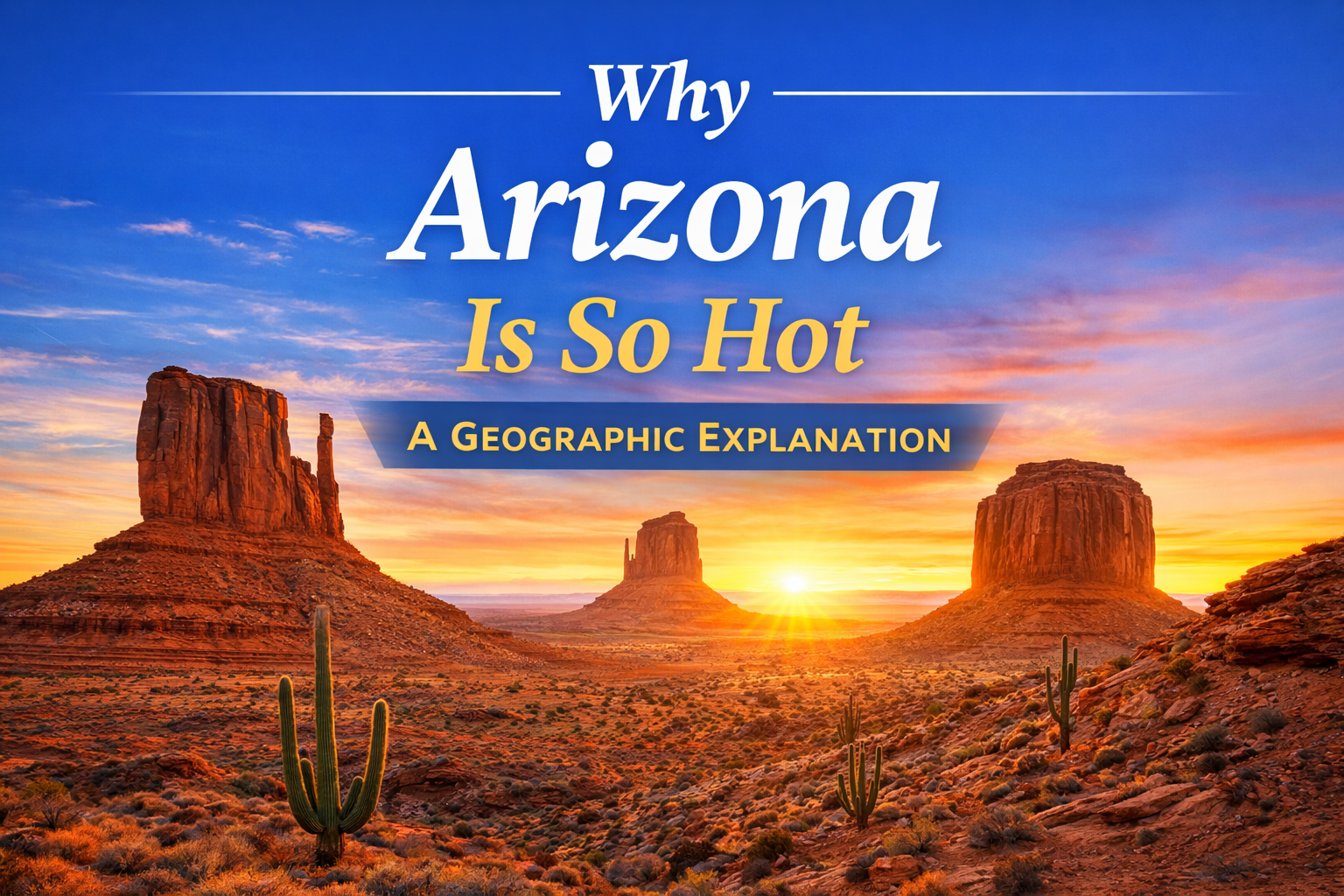
Arizona is known for its extreme heat, especially during the summer months when temperatures can exceed 40°C (104°F). Cities like Phoenix regularly experience intense heat waves that make it one of the hottest places in the United States.
But why is Arizona so hot? The answer lies in its geography, climate patterns, and natural features. In this article, we’ll break down the key geographic reasons behind Arizona’s high temperatures.
1. Desert Location
The most important reason Arizona is so hot is that much of the state lies within the Sonoran Desert.
Deserts are naturally hot because they receive a lot of sunlight and very little rainfall. The Sonoran Desert, which covers large parts of Arizona, is one of the hottest deserts in North America.
Key effects:
- Intense sunlight throughout the year
- Very low humidity
- Minimal cloud cover
All of these factors allow temperatures to rise quickly, especially during the day.
2. High Pressure Systems
Arizona is often affected by high-pressure systems, especially in summer.
High-pressure systems cause air to sink toward the ground. As air sinks, it becomes warmer and drier. This process is known as compression heating.
Result:
- Clear skies
- Strong sunlight
- Rising temperatures
This is one of the main reasons why Arizona experiences long periods of extreme heat.
3. Low Elevation in Key Areas
Some of Arizona’s hottest cities, like Phoenix, are located at low elevations.
Lower elevation areas tend to be hotter because:
- Air is denser and holds more heat
- Heat does not escape as easily
For example, the city of Phoenix sits in a valley, which traps heat and makes temperatures even higher.
4. Distance from Oceans
Unlike coastal states, Arizona is located far from large bodies of water.
Oceans help regulate temperature by:
- Cooling nearby land
- Adding moisture to the air
Since Arizona lacks this influence, temperatures can rise much higher compared to coastal regions like California.
5. Dry Air and Low Humidity
Arizona’s air is extremely dry, which plays a big role in its heat.
Dry air heats up faster than moist air because:
- There is less water vapor to absorb heat
- Sunlight directly warms the ground and air
This is why Arizona heat often feels intense but “dry” compared to humid places.
6. Clear Skies and Strong Sunlight
Arizona has many sunny days throughout the year.
With very few clouds to block sunlight:
- More solar energy reaches the ground
- Surface temperatures increase quickly
This consistent sunshine is a major contributor to the state’s high temperatures.
7. Urban Heat Island Effect
Cities like Phoenix experience an additional factor called the urban heat island effect.
This happens when:
- Concrete and asphalt absorb heat during the day
- Buildings trap heat and reduce airflow
At night, this heat is slowly released, keeping temperatures high even after sunset.
8. Seasonal Heat Peaks
Arizona’s heat becomes especially extreme in summer due to the position of the sun.
During summer:
- The sun is directly overhead
- Days are longer
- Solar intensity is stronger
This leads to peak temperatures, often making Arizona one of the hottest places in the country.
Conclusion
Arizona is so hot because of a combination of desert geography, dry air, low elevation, and strong sunlight. Its distance from oceans and frequent high-pressure systems further increase temperatures.
Together, these geographic factors create the intense heat that Arizona is famous for. While the climate can be challenging, it also shapes the unique landscapes and lifestyle of the region.