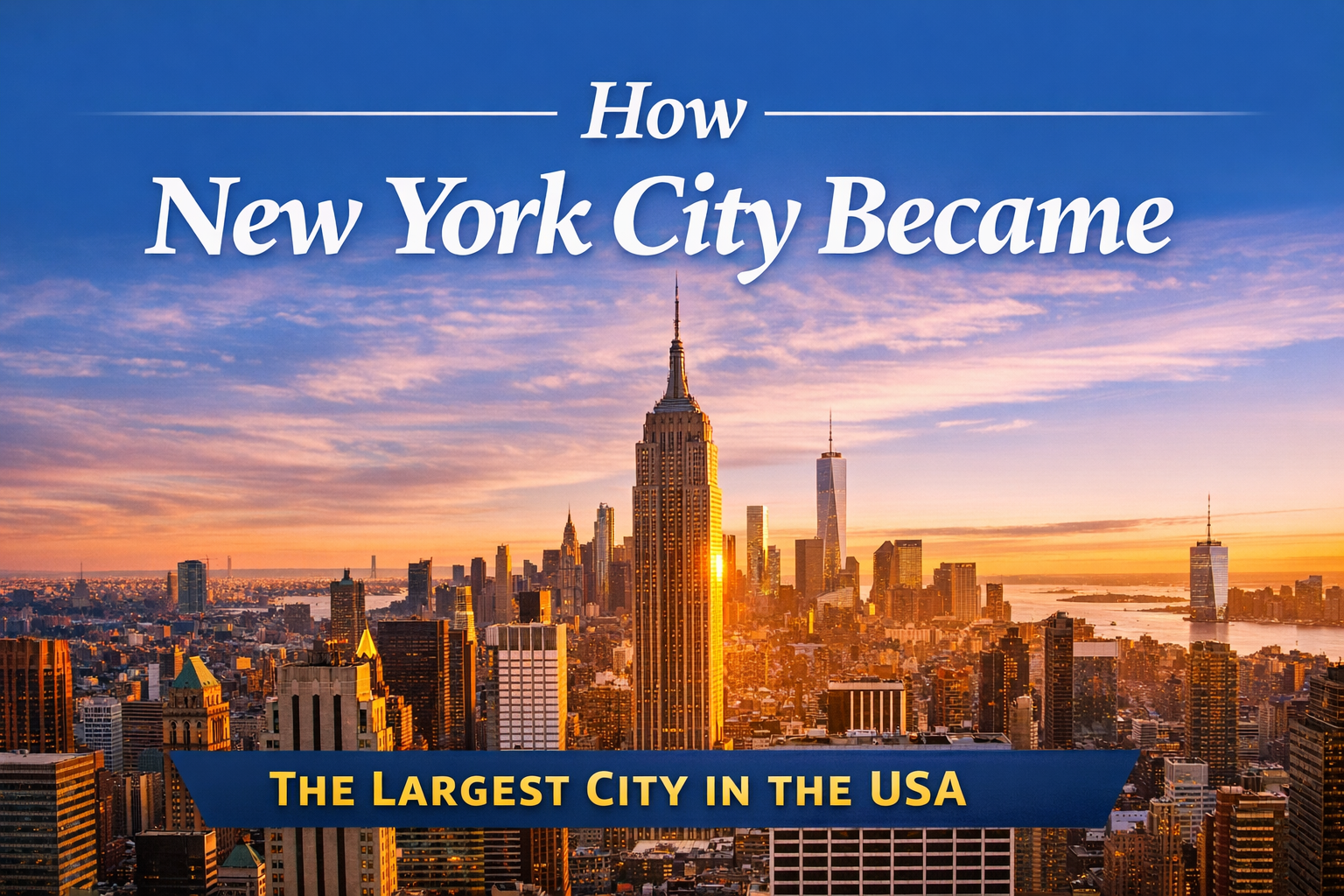
New York City is not just the largest city in the United States, it is one of the most influential cities in the world. Known for its towering skyline, cultural diversity, and economic power, NYC didn’t become the largest city overnight. Its growth is the result of geography, trade, immigration, and smart development over centuries.
In this article, we’ll explore how New York City rose from a small settlement to the biggest city in the USA.
1. A Strategic Geographic Location
One of the biggest reasons for New York City’s growth is its ideal geographic location.
The city is located at the mouth of the Hudson River, which connects the Atlantic Ocean to the interior of North America. This made it a perfect natural harbor for trade and transportation.
Ships from Europe could easily reach the city, and goods could be transported inland through rivers and canals. This geographic advantage gave New York a strong head start compared to other cities.
2. Early Beginnings and Colonial Growth
New York City was originally founded by the Dutch in the early 1600s as New Amsterdam. Later, the British took control and renamed it New York.
During the colonial period, the city began to grow as a trading hub. Merchants, traders, and settlers were attracted to its busy port and economic opportunities.
By the late 1700s, New York had already become one of the most important cities in the newly formed United States.
3. The Impact of the Erie Canal
A major turning point came in 1825 with the construction of the Erie Canal.
The canal connected the Hudson River to the Great Lakes, creating a direct trade route between the Atlantic Ocean and the interior of the country.
Why this mattered:
- It reduced transportation costs
- It increased trade and commerce
- It made New York the main gateway for goods entering the U.S.
As a result, businesses flourished, and more people moved to the city.
4. Immigration Boom
Another key factor in NYC’s growth was mass immigration.
During the 19th and early 20th centuries, millions of immigrants arrived in the United States through Ellis Island, which is located in New York Harbor.
People came from Europe and other parts of the world in search of better opportunities.
Impact of immigration:
- Rapid population growth
- Cultural diversity
- Expansion of neighborhoods and communities
This made New York City not only larger but also one of the most diverse cities in the world.
5. Industrialization and Economic Power
As the United States industrialized, New York City became a center of business, finance, and manufacturing.
The rise of Wall Street turned the city into the financial capital of the country. Factories, offices, and businesses created thousands of jobs.
People from across the country moved to NYC for work, further increasing its population.
6. Expansion into Five Boroughs
In 1898, New York City officially expanded into five boroughs:
- Manhattan
- Brooklyn
- Queens
- The Bronx
- Staten Island
This consolidation played a huge role in making NYC the largest city in the U.S.
Instead of being separate cities, these areas were united into one massive urban center, increasing both land area and population.
7. Urban Development and Infrastructure
New York City continued to grow due to strong infrastructure and urban planning.
Key developments:
- Subway system (one of the largest in the world)
- Bridges like the Brooklyn Bridge
- Skyscrapers and high-density housing
These developments allowed millions of people to live and work in a relatively small area, boosting population density.
8. A Global Cultural and Economic Hub
Today, New York City is more than just a large city, it is a global hub.
It leads in:
- Finance
- Media
- Fashion
- Technology
- Tourism
Its global influence continues to attract people from all over the world, helping it maintain its position as the largest city in the United States.
Conclusion
New York City became the largest city in the USA due to a combination of geography, trade, immigration, and development. Its natural harbor, strategic location, and economic opportunities made it a magnet for people and businesses.
From a small colonial settlement to a global powerhouse, NYC’s growth story is a perfect example of how geography and human activity shape cities.